
News
“I Can’t” Becomes “I Can”: Extending Support for People with Visual Impairments Through Innovation
Contents
“Visual Impairment Rehabilitation Workshop“ at Tokyo Office
When people hear that someone has visual impairment, many assume that person must be unable to do many things in daily life. However, thanks to the development of various assistive devices—born from innovation over a long history—and advances in ICT (Information and Communications Technology), assistive technologies that support the lives of people with visual impairments have become practical, helping them live independently.
Recently, the Japan Guide Dog Association held the “Visual Impairment Rehabilitation Workshop” at its Tokyo office. Aimed at staff members from welfare facilities, organizations, and care and counseling agencies in Tokyo, the workshop used simulated visual impairment experiences to help participants understand the challenges people with visual impairments face. Together, they explored future approaches to engagement and methods of support. It also provided an opportunity to experience assistive tools and ICT support technologies designed for people with visual impairments.
Workshop Overview:
1. Group discussion on activities that would become impossible if one lost their sight
2. Simulated visual impairment experience
3. Introduction to assistive tools
4. Introduction to ICT assistive technologies and apps
5. Group discussion to categorize the “Impossible” activities identified earlier into “Possible with tools,” “Possible with practice,” or “Impossible”
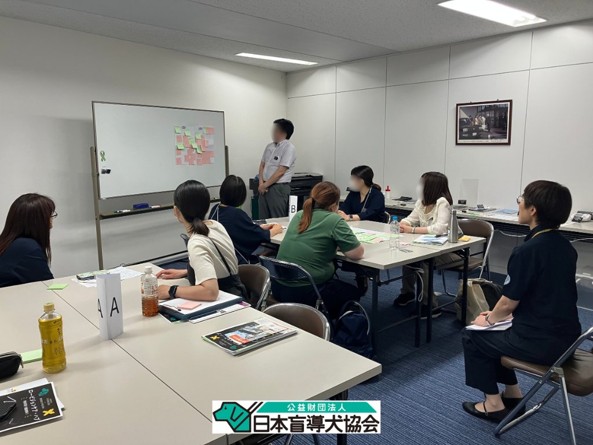
Workshop participants presenting on the things they would no longer be able to do if they lost their sight
Learning that begins with experiencing “not being able to see”
The workshop began with an exercise asking, “If you lost your sight tomorrow, what would you no longer be able to do?” Participants offered many suggestions, such as “reading books,” “using a cell phone,” “shopping,” and “cooking,” and seemed to realize anew just how much our daily lives depend on information obtained through sight. Afterward, through simulated experiences that replicated the visual effects of cataracts and narrowed visual fields, participants experienced first hand how people with visual impairments perceive the world around them. Participants gained many insights through these hands-on experiences, such as how readability changes significantly depending on font size and color combinations, and that larger text isn’t necessarily easier to read.
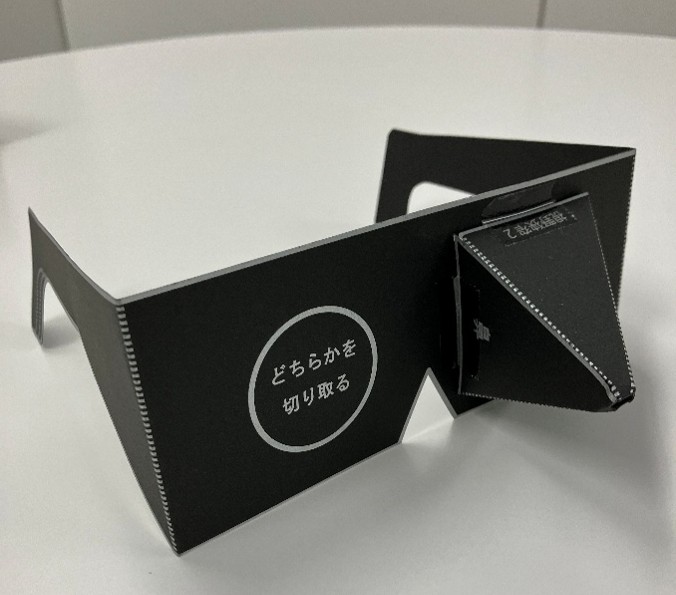
“Narrowed Field of Vision” simulation glasses
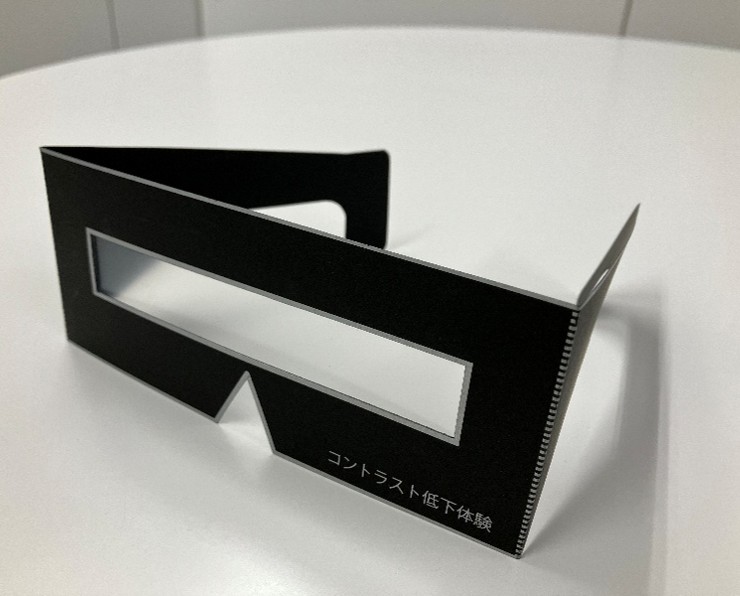
“Reduced Contrast” simulation glasses
Various Adaptations to Aid Daily Life
Next, we introduced assistive tools. There are various devices that supplement visual information with sound, such as wristwatches and thermometers that announce numerical readings aloud. Additionally, people can write by using tools like signature guides that indicate where to sign, line guides to help write characters straight, and vertical line guides for filling out envelopes. For some people, writing white text on black paper is easier to read than writing black text on white paper. When eating, using black tableware creates a clear contrast with the food. Having these thoughtfully designed, convenient tools readily available can shift the perception from “daily life becomes difficult, and I can’t do many things” to “with the right adjustments, there are things I can do.”
Smartphones are gaining attention as ICT support technology for people with visual impairments
A smartphone screen reader reads aloud text and buttons on the screen. This makes it possible to send and receive emails, search the internet, and use social media via voice commands. During the workshop, participants learned that people with visual impairments use smartphones and computers daily to gather information and communicate—a revelation that seemed like a major discovery for them.
AI Reads Out Surrounding Information
In recent years, thanks to advances in AI technology, there are increasing instances where a smartphone’s camera acts as a “substitute for the eyes.” Image recognition apps designed for people with visual impairments recognize text, objects, and scenery captured by the camera and describe what they see using voice. These apps are used not only to read mail and documents but also to identify product packaging and describe the surrounding environment. They can also read aloud restaurant menus and provide audio descriptions of directional signs at train stations and around town. By utilizing these technologies, opportunities for people to independently obtain information and make decisions—even in situations that previously required assistance from others—have greatly expanded.
Remote Support Apps That Connect People
Support that leverages human connections—not just AI—is also evolving. Remote support apps that connect people with visual impairments to volunteers online let users share their smartphone camera feed and ask questions such as,
“Can you tell me the expiration date of this product?” or
“Can you confirm what this document is?”
This system, which lets users connect with someone when they’re in trouble, provides a strong sense of security. During this workshop, we highlighted how these remote support apps are playing a vital role as essential tools that support daily life.
Assigning “Voice Names” to Everyday Items
ICT support technologies aren’t limited to AI and smartphones. In this workshop, we also introduced information management devices that utilize voice tags. By using tags and a reader, users can record voice information for everyday items such as medicine, food, and clothing. Simply holding the reader over a tag causes it to read aloud the registered content—such as “high blood pressure medication,” “soy sauce,” “winter jacket,” and other registered information. This enables people with visual impairments to identify items on their own, even those that are difficult to distinguish by appearance alone.
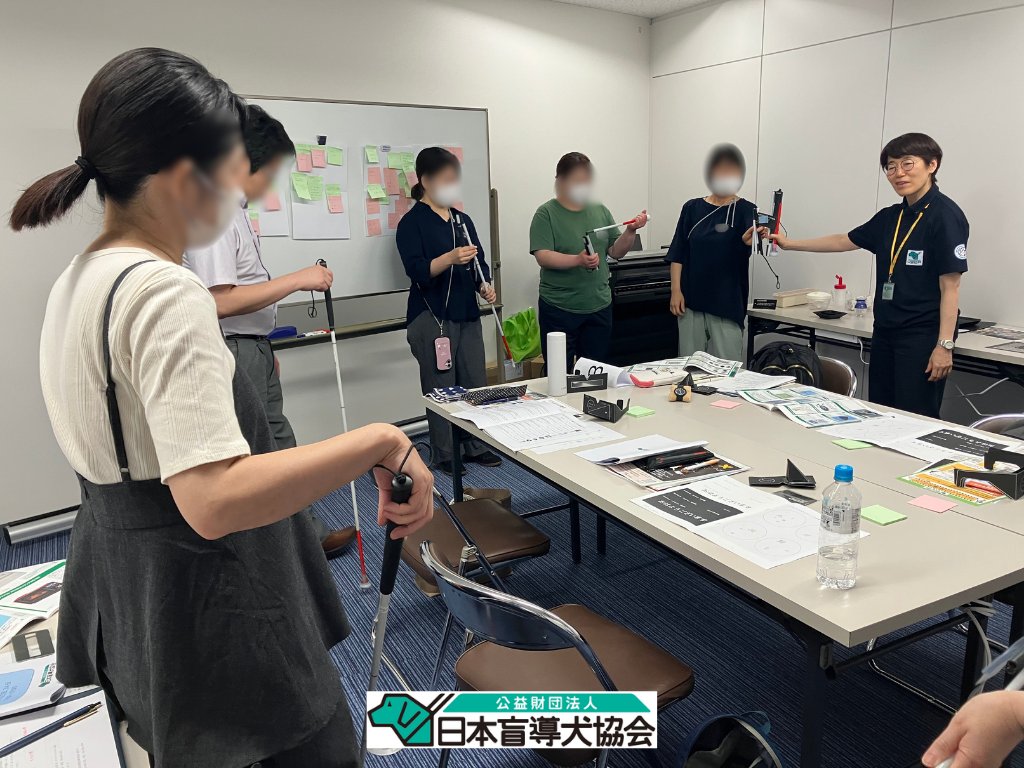
Workshop participants trying out long canes
From “Can’t” to “Can”
At the beginning of the workshop, participants shared many examples of things they felt they “wouldn’t be able to do” if they lost their sight. However, as they learned about the various ingenious solutions, assistive devices, and tools that support daily life—as well as ICT support devices and apps—their understanding deepened regarding how many of those challenges could be transformed into “can.”
From a survey conducted later, we received many comments such as:
“As a care manager, I feel a strong desire to reduce situations where necessary information doesn’t reach those with visual impairments simply because caregivers lack the knowledge. I want to keep learning, gather a wide range of information, and share this knowledge with my colleagues in a grassroots way”
and
“In working with people who are visually impaired, I learned that each person’s vision, lifestyle, and challenges are unique. Going forward, I want to prioritize listening to the individuals themselves, share what I’ve learned with my workplace and the community, and help create an environment where we can support one another when difficulties arise.”
We received many comments like these.
Technological advancements do more than simply provide convenience. They expand the options available to people with visual impairments, allowing them to live authentically and participate in society. Furthermore, when local support providers and each of us understand these possibilities and the necessary accommodations, we help build a society where everyone can live comfortably.